“Will it be a boy or a girl?” – This question is the most common question in marriage and pregnancy. Everyone wants to know!
But did you know that the sex of the baby is actually decided in the first second of fertilization – when the egg and sperm meet? Even before spending 9 months in the womb!
Today I will tell you – gender is decided, when it develops physically, and when it is revealed. This poor story is really very interesting.
When is gender decided?

The straight answer – at the moment of fertilization!
When the sperm meets the egg – the gender of the child is already decided in each other. Nothing can change the gender during the 9-month pregnancy – it is already written!
Physically, however – it takes time for the body to develop. Let’s understand why..
Chromosomes – the secret of gender
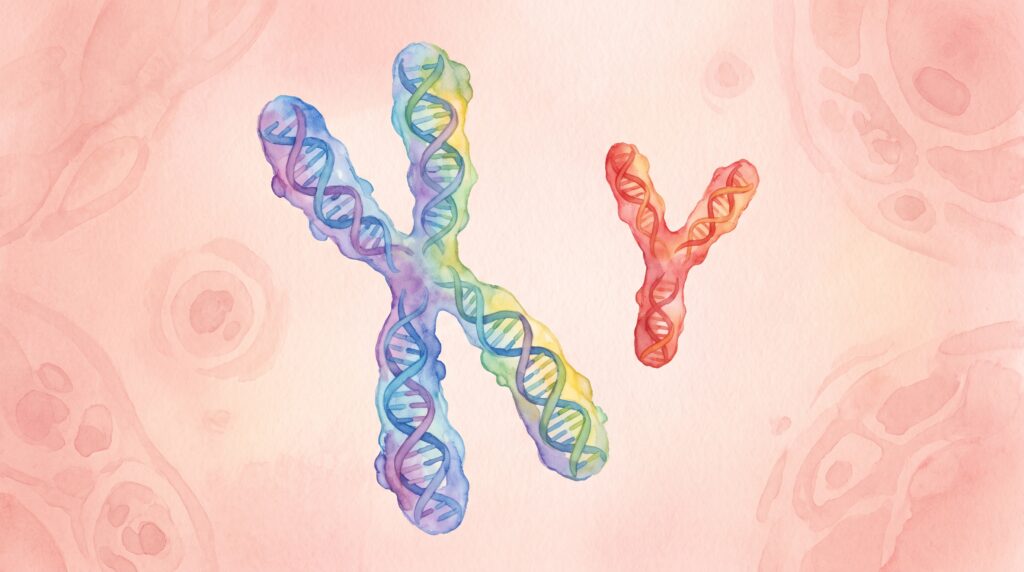
Every human has 46 chromosomes in each cell – in 23 pairs.
One of these pairs determines gender – the sex chromosomes:
Females: XX chromosomes Males: XY chromosomes
Egg (from the mother’s side):
The mother’s body can donate an X chromosome — since the mother is XX, each egg will only have one X.
Sperm (From the Father’s Side):
Dad is XY – so some sperm carry the X chromosome, some carry the Y chromosome.
This is what magic happens:
If X sperm meets egg → XX → girl! 👧
If the Y sperm meets the egg → XY → Baby Boy! 👦
So technically – the father decides the sex of the baby! (Mom always gives X – the father’s contribution is different!)
When does gender develop physically?
This is the interesting part – gender is determined at fertilization, but physically, boys and girls look the same at first!
By week 6-7: Boy and girl embryos look exactly the same – there is no physical difference. Both have the same basic structures that will later develop separately.
Week 7: The SRY gene (located on the Y chromosome) is activated – this gene “signals” the testes to develop (if it’s a boy).
Week 8-9: In boys – the testicles develop, and testosterone begins to be produced. In girls – the ovaries develop.
Week 11-12: The external genitalia (the parts visible from the vagina) develop and become visible – but are still difficult to distinguish clearly on ultrasound.
Weeks 14-16: External differences will become apparent.
Weeks 18-20: Gender is usually clearly visible on anatomy scans!
What is the difference between X and Y chromosomes?
Y Chromosome:
- is much smaller than X.
- Surf does some genes.
- The most important gene: SRY – which stimulates male development.
X Chromosome:
- It is very big.
- It takes a lot of genes.
- Very important genes are equal – except for surf sex
Fun fact: Girls (XX) have two X chromosomes — so they have two copies of some genes. Boys (XY) only have one X — so some conditions like color blindness are more common in boys (because there’s no backup X)!
When is the gender of the baby revealed?
Now the practical question — when can you know?
Method 1 – NIPT blood test (quickest)
When: From week 10 Accuracy: 99%+ What: There are pieces of the baby’s DNA in the mother’s blood — this test detects them. Note: This is primarily to screen for genetic conditions — gender confirmation is a secondary benefit.
Method 2 – Anatomy Ultrasound (Most Common)
When: Weeks 18-20 Accuracy: 95-99% (if baby cooperates!) What: The ultrasound technician observes the baby’s external genitalia. Note: Baby’s position matters — sometimes baby “hides”!
Method 3 – CVS or Amniocentesis
When: Weeks 10-16 Accuracy: Almost 100% Note: This test is done for medical reasons – not usually for gender.
Method 4 – Gender Revealing DNA Test
When: After week 8-9 Accuracy: High Note: Private companies offer – requires giving a urine sample from a home kit.
Common myths about gender busted!
We’ve busted the myths before — but it’s important to understand gender-specific myths separately:
Myth: “Faster heart rate means a girl is pregnant” ❌ Myth — Heart rate varies with activity level, not gender.
Myth: “The shape of a pet indicates gender” ❌ Myth — The shape of a pet depends on the mother’s body type and the baby’s position.
Nausea: “More nausea means a girl is pregnant” ❌ Mostly myth — Nausea is caused by hCG levels, which vary from pregnancy to pregnancy.
Myth: “Food cravings indicate gender” ❌ Myth — Cravings are caused by hormones and nutritional needs, not gender
Myth: “Ring Test or Pendulum Test” ❌ Myth – There is no scientific basis for them.
These are all for fun — not reliable gender predictions!
Is gender change possible?
This question is sometimes asked – and the answer is technically complex.
Chromosomal sex: This is decided at fertilization before birth and does not change – each cell has the same chromosomes.
Physical sex (sexual characteristics): Can be changed through medical procedures – but this is a completely separate and complex topic.
Interesting scientific facts – about sex
Fact 1: There are about 105 boys born for every 100 girls in the world — but the infant mortality rate for boys has been slightly higher historically, so the ratio is balanced.
Fact 2: The Y chromosome is getting smaller over time — millions of years ago it was the size of an X!
Fact 3: There are some rare cases where chromosomes are XX but a baby boy develops — or XY but a girl develops. This suggests that gender development is more complex than chromosomes!
Fact 4: Identical twins are always the same sex (the same chromosomes that are separated) — but fraternal twins are different sexes.
Fact 5: In some species, temperature determines gender — in humans, it is entirely determined by chromosomes!
Gender Development Timeline
| Week. | What happens? |
|---|---|
| Fertilization | Decide sex chromosomally. |
| Week 6-7 | Boy/girl are physically the same. |
| Week 7 | SRY gene activation (in boys) |
| Week 8-9 | Internal organs begin to develop. |
| Week 11-12 | There are apparent differences. |
| Week 18-20 | It is usually clearly detected on ultrasound. |
Frequently Asked Questions
Q: When is the sex of the baby determined? From the moment of fertilization – when the sperm meets the egg. The X or Y chromosome decides in a split second whether it is a boy or a girl.
Q: Does the mother determine the sex? No – the mother always gives the X chromosome. The father’s sperm decides – if the X sperm comes, it is a girl, if the Y sperm comes, it is a boy!
Q: When is the gender revealed on ultrasound? Usually at 18-20 weeks, the anatomy scan is the same. But the blood test (NIPT) can detect it from week 10.
Q: Is it possible to predict the sex 100% accurately from ultrasound? 95-99% accurate – but depends on the position of the baby. Sometimes the baby hides!
Q: Do boy and girl fetuses look the same in Sharia? Absolutely! They are physically identical until week 6-7 – from week 8-9, internal differences become noticeable.
The last thing
Boy or girl – this decision is made in a microscopic moment. One sperm, one egg, one chromosome – and a new human being is decided.
But remember this too – gender is a part of a child’s identity. They will develop their own personality, their own dreams, their own loves – all of this on their own. And all of that – whether it’s a boy or a girl – will be completely unique and special
We celebrate this on the beat of a small heart – the uniqueness of every life, every child’s own, beautiful story. 🌸
Boy or girl – did you have a surprise or did you find out first? Tell us in the comments! And follow our TikTok for more amazing facts like this every day!
This article is for educational purposes only. Please consult your doctor for any questions regarding gender and pregnancy.