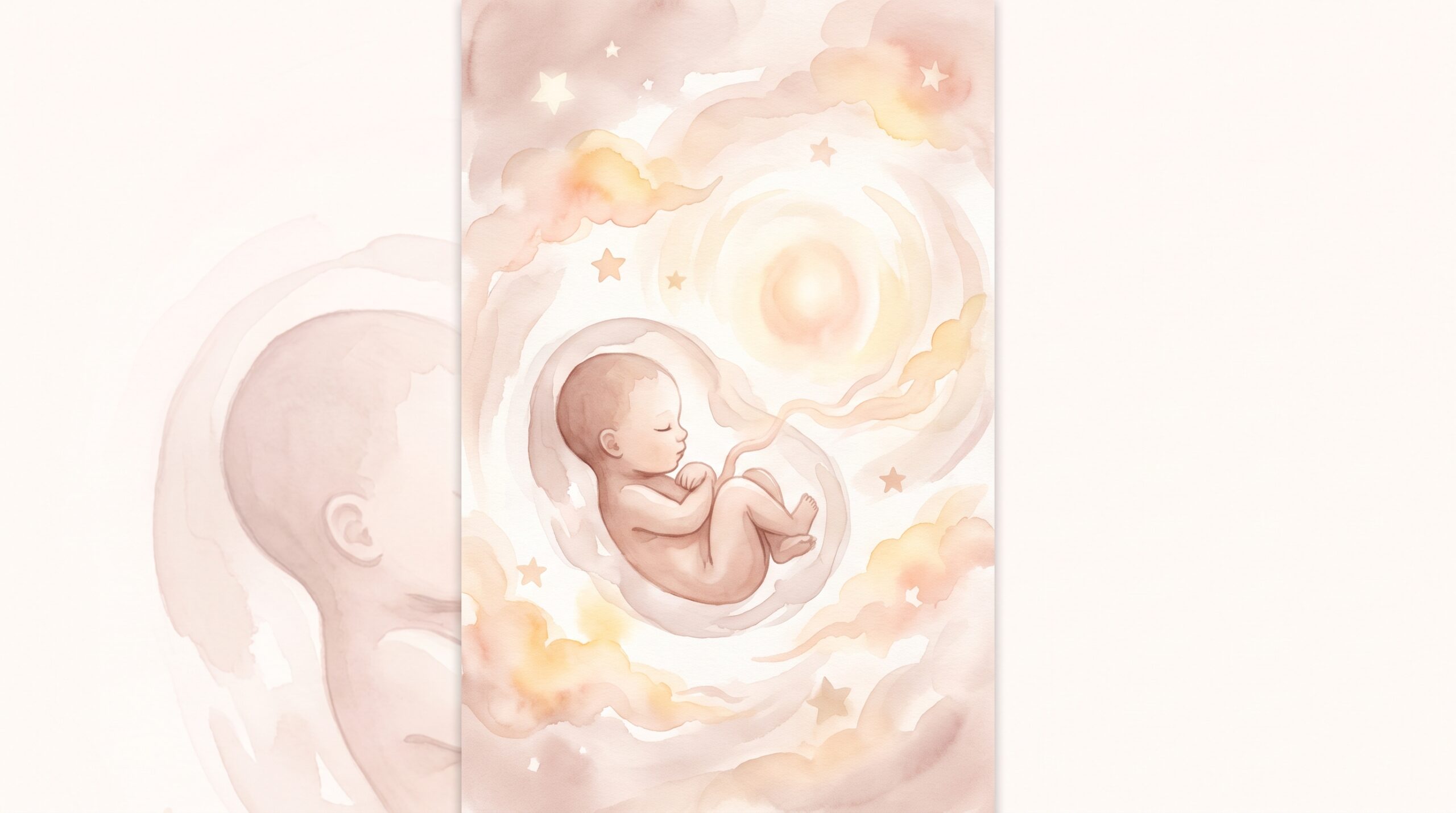
This question comes to the mind of many mothers — “Did my baby sleep yet? Is he resting?”
And the answer is very interesting — yes, the baby sleeps! And not just sleeps – there is deep sleep, light sleep, and REM sleep. He also dreams!
A baby’s sleep is completely different inside the womb — and today I will tell you all about it in detail.
When does a baby start sleeping in the womb?
First, it’s important to understand when the concept of “sleep” begins in the womb.
Weeks 1-7: When the brain is not yet fully developed enough to have proper sleep cycles – the brain is basically in a state of unconsciousness.
Weeks 8-12: Basic patterns of activity begin to emerge in the baby’s brain — but structured sleep isn’t yet happening.
Weeks 16-20: As the brain develops, the baby begins to switch between rest and activity — this is the first step to proper sleep!
Weeks 25-28: Proper sleep cycles begin here — and REM sleep begins here too!
Weeks 32+: Sleep cycles become exactly like newborns — deep sleep, light sleep, REM can all be clearly distinguished by ultrasound and brain monitoring.
How long does a baby sleep in the womb?
You might be surprised – the baby spends 90-95% of its time sleeping in the womb!
Yes, really! The baby is only active 5-10% of the time.
Why is this? Because:
- Growing is a very energy-intensive process.
- Deep rest is needed for brain development.
- Baby is not distracted by the spring star.
So when you don’t feel movement — most of the time baby is resting!
Baby’s sleep cycle – what does it do?
Unlike adults, babies also have different sleep stages:
Restful sleep (deep sleep)
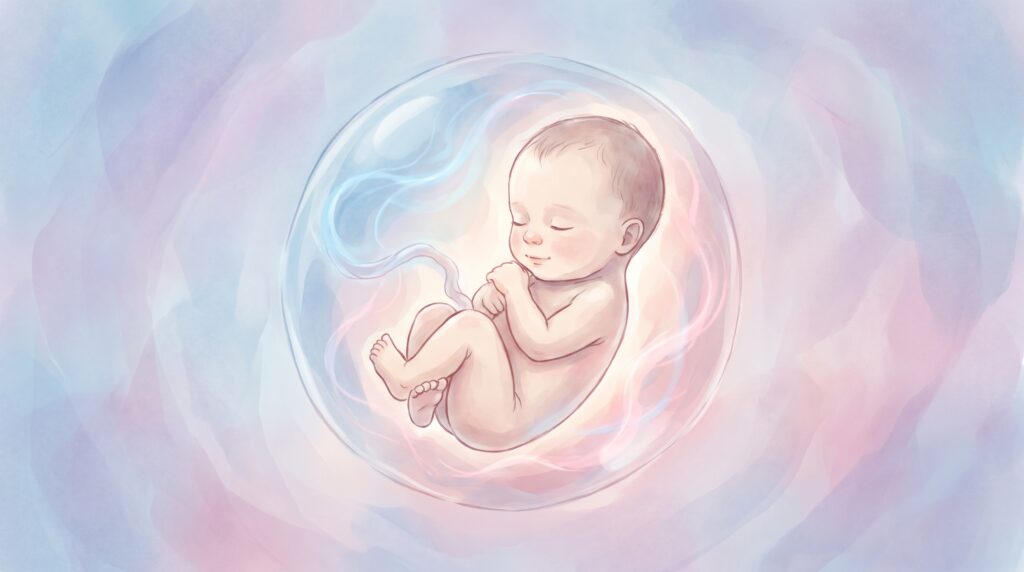
What happens:
- Baby is still alive.
- Keep movements to a minimum.
- Slow or irregular heartbeat
- Brain activity work
Cutaneous: Approximately 20-40 minutes per cycle
When developed: Clearly developed after week 28
Active sleep (REM – rapid eye movement)
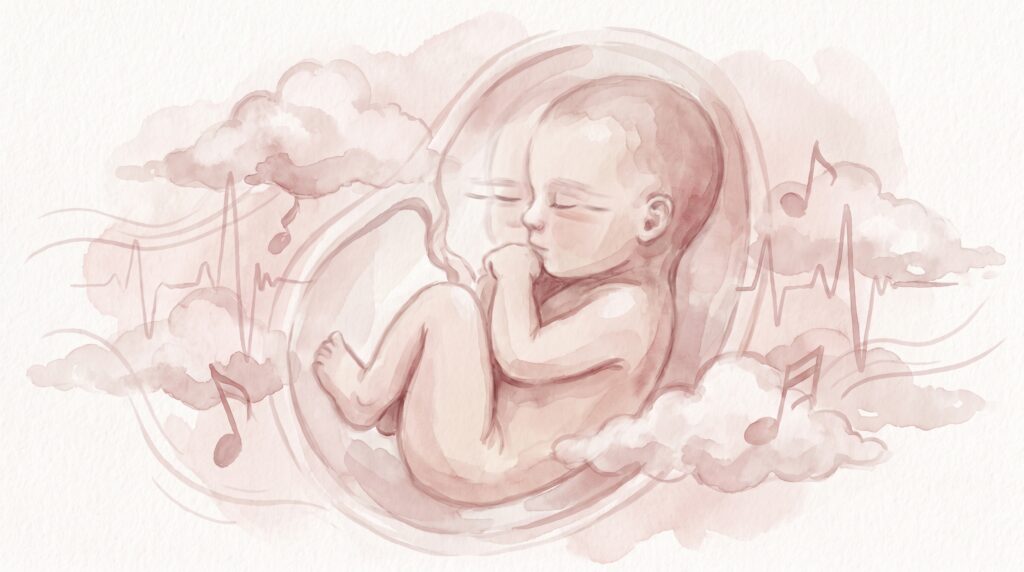
What happens:
- The baby’s eyes are closed but moving (REM movement!)
- Small body movements
- Irregular heartbeat
- The mind is highly active.
- This is the stage where dreams come true!
Cutaneous: Approximately 20-40 minutes per cycle
When does development occur: Begins at weeks 23-25, clearly established at weeks 28+
Transitional Sleep
What happens: The stage between deep sleep and active sleep — baby moves a little, then settles down.
Do you dream, child? What do you dream about?
This is the most interesting question! And the answer is – yes, REM sleep occurs, so technically dreams occur.
But what do babies see?
Honestly, we can’t — because babies don’t see anything! But researchers believe that babies experience hallucinations:
- Sensory memories – what was felt, heard, or tasted in the womb
- Physical sensations – sensations of moving your hands and feet
- Familiar sounds — mother’s heartbeat, voice
- Internal feelings – warmth, floating
These aren’t exactly “dreams” like the ones we see – but brain activity is definitely present in REM!
Baby’s sleep schedule – concept of day and night
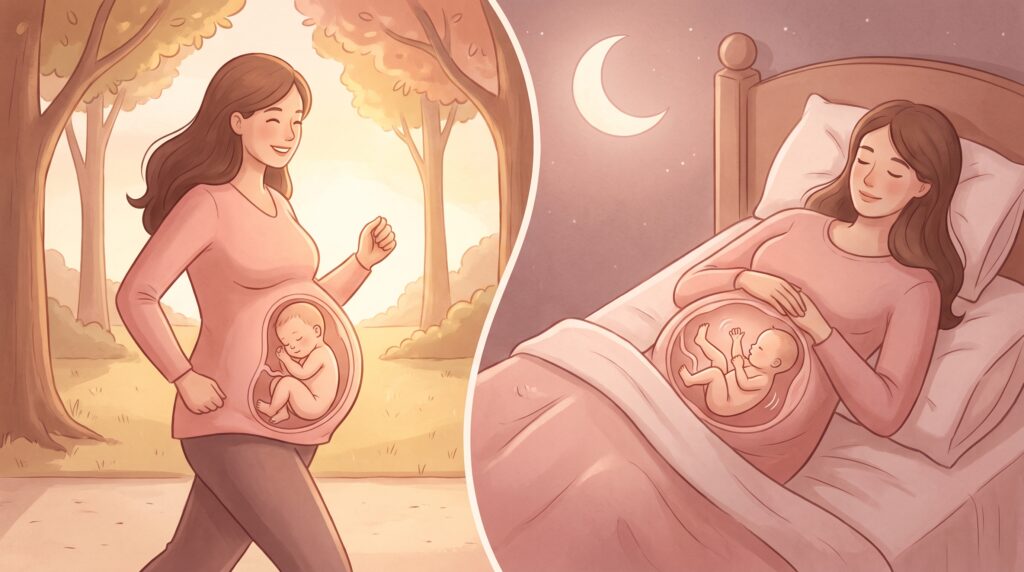
Here’s an interesting thing – a baby has no concept of day or night in the womb!
In the womb:
- It is always dark.
- The temperature remains constant.
- The noise level remains constant.
So the baby’s sleep schedule is different from the mother’s!
The general pattern is this:
When the mother is active (during the day): The baby’s movements are rocked by the mother’s movements — just like rocking in a cradle! The baby sleeps more during the day.
When the mother is resting (at night): The baby becomes active — because he doesn’t get the “rocking” sensation! That’s why there are more movements at night.
That’s why many expect that moms say: “The baby becomes really active at night!”
Do the mother’s activities affect the baby’s sleep?
Of course – and this is quite interesting:
Loud noise: A sudden loud noise can wake a baby from sleep and cause a startle reflex – just like we do!
Mom’s movement: As mentioned before – the mother’s walking, doing activities, makes the baby sleep.
Maternal stress: High stress hormones pass into the amniotic fluid and affect the baby’s sleep quality. That’s why prenatal rest is essential!
Light: At 26+ weeks, the baby can detect light – bright light can disrupt sleep. The womb is naturally dark, which helps the baby sleep well.
Mom’s sleep: When the mother sleeps well – the baby is also more settled. There’s a connection!
Can you see a baby sleeping on an ultrasound?
Yes! Modern ultrasound can observe the stages of a baby’s sleep:
In quiet sleep: the baby is still awake – minimal movement, fixed position.
In active sleep: the baby’s small movements are observed – waving hands, waving paws, shaking a little – all asleep!
Interesting fact: when an ultrasound is done and the baby is sleeping – the vibration of the transducer sometimes wakes the baby up and starts moving! Many mothers smile when they see this.
Sleep Development Timeline
| Week. | Sleep Development |
|---|---|
| Week 8-12 | Basic rest/activity patterns. |
| Week 16-20 | Switching between rest and activity |
| Week 23-25 | REM sleep is noisy. |
| Week 28 | Establish a clear sleep cycle |
| Week 32+ | Newborn jays’ sleep patterns. |
| Week 36+ | 90-95% time sleeping |
Sleep after birth
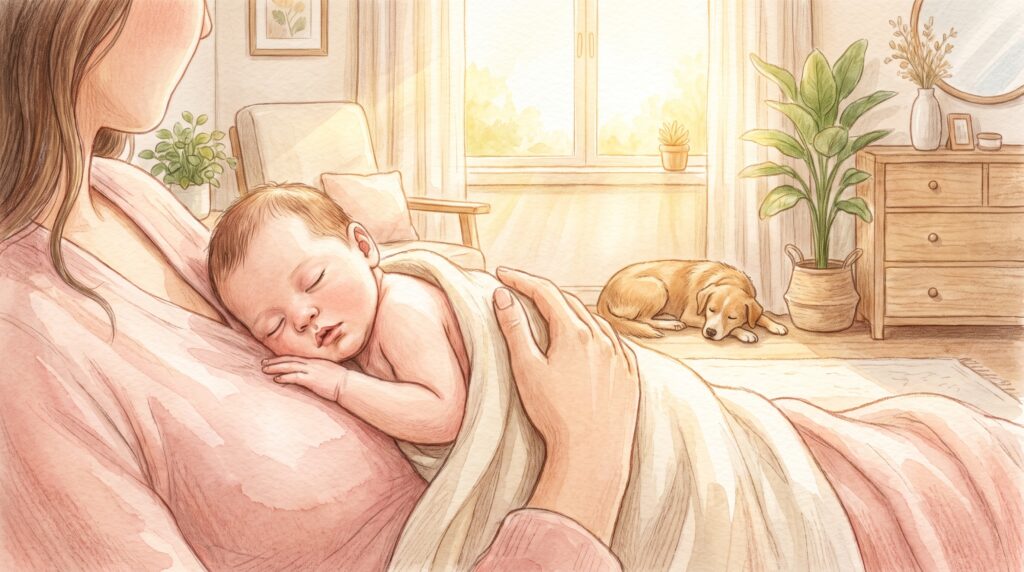
When baby is born – sleep patterns are already in place! But some things change:
Day/night confusion: There was no day and night in the womb – the world has a day and night cycle. It takes a baby 6-8 weeks to figure this out!
Shorter sleep cycles: Newborns have shorter sleep cycles than adults — about 45-50 minutes per cycle versus 90 minutes for adults.
More REM: Newborns have a higher proportion of REM sleep — for brain development!
Mother’s scent: The familiar things that babies know — their mother’s scent, their heartbeat — all help soothe a newborn to sleep.
Tips – For healthy sleep in a child (infants)
There are some things a mother can do to help her baby sleep in the womb:
✅Regular sleep schedule: Set your own sleep routine – even the baby settles.
✅ Stress management: relaxation techniques, meditation, gentle yoga.
✅ Avoid loud noises: especially at night – it disturbs the baby’s sleep
✅ Soft music: Calming music – can improve baby’s sleep quality.
✅ Sleep on the left side: blood flow is better to the baby – and the baby is more comfortable
Frequently Asked Questions
Q: How many hours does a baby sleep in the womb? A baby sleeps about 20-21 hours out of 24 hours — and is active for about 3-4 hours! This is especially true in the third trimester.
Q: Can I wake my baby up in the womb? Yes — a loud noise, a cold drink, or gentle pressure from a pet can wake the baby. But not always necessary — let the baby rest!
Q: Does a baby’s REM sleep prove that they dream? REM sleep is a confirmation. Does the baby experience REM sleep at all? It’s not 100% confirmed. But brain activity is a must.
Q: Why is my baby so active at night? Why do your movements during the day rock the baby? When you rest at night, it becomes a rocking band and the baby becomes active!
Q: Are newborn sleep patterns related to sleep in the womb? Absolutely! A newborn’s sleep cycle develops in the womb — so the newborn is exposed to familiar sounds (mother’s voice, heartbeat) and sleeps in the sun.
Last thing
The baby spends 90 percent of its time in the womb resting — growing, dreaming, developing. It is the most peaceful existence in the world — warm, safe, connected.
When you feel the baby’s movement at night — it is time for him to wake up. And when it is quiet — he is probably in the world of sleep, where there is no fear, no worry — the surf is warm, the surf is soothing.
These are the moments that are remembered after birth — when the baby cries at night and you try to give him a sense of our warmth, our security again.
We celebrate this on the beat of a small heart — these small, but very cute stories. 🌸
Do you ever wonder if the baby is sleeping? Tell us in the comments! And follow our TikTok Crane Rose for more such facts!
This article is for educational purposes only. Please consult your doctor for any concerns.