When baby first moves — wow, it feels different. But as pregnancy progresses, a pattern of movement begins to emerge — and this pattern is actually an important indicator of baby’s health.
Is excessive movement normal? Is movement worrying? Sometimes it’s very active one day and quiet the next — is that okay?
Today I’m giving you a little guide — what to expect, and when to see a doctor about baby movement.
Basic timeline of baby movements
First, it’s important to understand when movements start and who develops them.
Weeks 7-8: Baby starts to move — but is too small to feel.
Weeks 14-16: Movements are large and noticeable — can be seen on ultrasound.
Weeks 16-25: Mom feels them for the first time — like fluttering, bubbling, or a slight tickle.
Weeks 24-28: Movements are clear and kicks are restricted — partner can feel them too.
Weeks 28+: Movements should be strong, regular, and predictable.
Weeks 36+: Movements feel a little different because of the location of the baby — but the frequency should remain the same.
Normal movement patterns – what is expected of a crane?
Every baby’s pattern is different.
This is the first and most important thing – every child has their own unique movement pattern. Some children are very active, some are a little quiet. Both can be normal!
The thing to pay attention to is what is normal for your child — comparing it to other children.
What happens on a typical day?
Baby has about 50-60 movement episodes in 24 hours — but mom doesn’t feel them all!
Babies sleep in 20-40 minute sleep cycles during the day — and they don’t move during this time. This is normal!
When does a baby become most active?
There are certain times when your baby is usually most active:
At night: Your movements during the day are like lullabies to your baby — at night, when you rest, your baby is most active!
After eating: Your baby’s blood sugar levels rise — especially after eating sweets!
When you are awake: Gravity is at work — your baby moves more freely.
Listening to music: Especially bass sounds — your baby reacts
When you are nervous or excited: Adrenaline rushes to your baby.
After drinking a cold drink: The temperature change is shocking to your baby.
Different types of movements – what does it feel like?
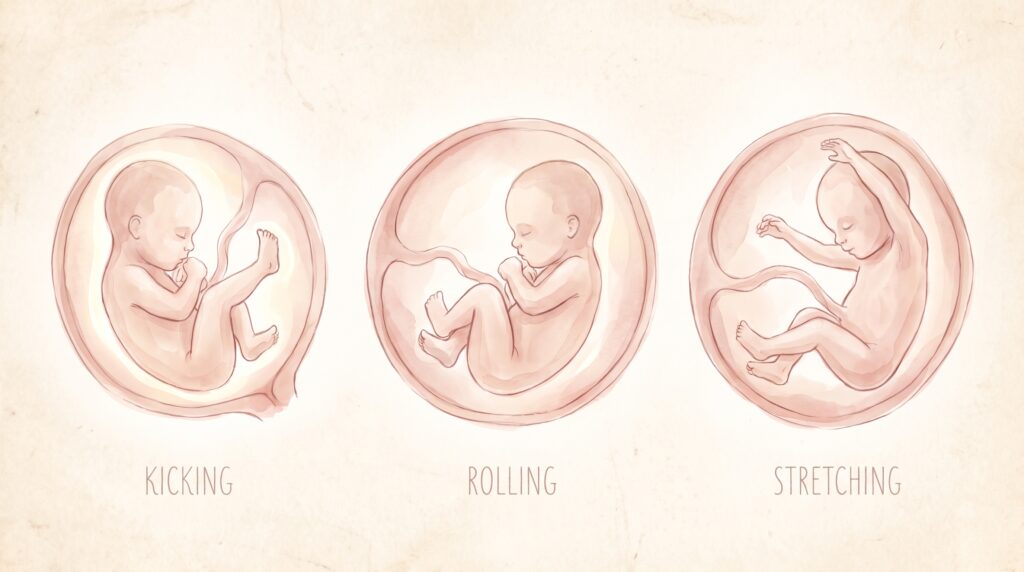
Kicks and punches.
These are the most common and clearly felt movements. After weeks 24-28, they feel like a strong thud.
Rolling and turning
A slow, wave-like movement – baby is changing position. Common at week 30+.
Stretching
Baby stretches his hands or paws — a long, slow sensation.
Hiccups

Regular, rhythmic small movements — distinct from kicks, in a more consistent rhythm. Common at 24+ weeks. Totally normal!
Startle (Moro reflex)
Sometimes a baby will suddenly startle at a loud noise or sudden movement — this is a startle reflex, a sign of normal development!
Kick counting – why and to whom?

After week 28, doctors often recommend counting kicks — it’s an easy way to check on the baby’s well-being.
Method 1 – Count to 10.
Choose a specific time to cry (usually in the evening or after eating when the baby is active):
- Sit or lie down in a comfortable position.
- Start the timer.
- Count the baby’s movements.
- See how long it takes to make 10 moves.
Normal: 10 movements in 2 hours — but most healthy babies make 10 movements in 30-60 minutes!
Method 2 – Daily Pattern Notes Kerin
Don’t follow a specific routine — just notice the daily pattern. If your child is usually active in the morning — notice whether he or she is active or not.
What is normal and what is not?
✅ This is normal:
- One day more active, the next a little quieter.
- Excessive movement at night
- Hiccups (can also occur daily)
- Feeling motivated is a bit of a chore when you’re busy.
- Movements may feel a little different at week 36+ (baby has grown, spacewalks)
- The baby should not move during sleep.
⚠️ Call a doctor if:

- Not feeling 10 movements in 2 hours (weeks 28+)
- The movements have suddenly become dramatic.
- No movement felt for a day (in the second/third trimester)
- The child’s normal daily pattern has completely changed.
- There’s nothing your heart is saying — trust your gut!
Daily monitoring in week 28+
Follow these simple routines in the third trimester:
Sabha: Notice that the baby has made some movements — usually the baby is active after breakfast.
Evening: If movements seem normal during the day — great!
If worried: Eat something sweet, lie on your left side for 30 minutes, and count the movements. If there are not 10 in 2 hours — call the doctor.
Answers to common questions
“Baby is very quiet today – what to do?”
Try this first:
- Drink cold water or juice.
- Eat something sweet.
- Lie on the left side.
- Wait 30 minutes.
If the movements still don’t work – call the doctor. It’s better to be safe!
“The baby suddenly started moving a lot – is this normal?”
Usually yes — sometimes the baby is in an active phase. Lichen Agar’s movements seem very violent or painful – get checked by a doctor.
“Will the 36 week wind movements be normal?”
It’s a common myth that movements naturally work in late pregnancy. This is not true! The frequency should stay the same — surf type may differ (fewer kicks, more rolls). If the frequency works – be sure to tell the doctor.
Quick Reference Table
| Situation | What to do? |
|---|---|
| 10 moves in 2 hours | ✅ Normal |
| More active at night | ✅ Normal |
| Daily hiccups | ✅ Normal |
| A little quiet one day | Eat dessert, lie down, count. |
| It doesn’t happen in 2 hours. | ⚠️ Call the doctor. |
| No sudden movement. | ⚠️ Doctor immediately. |
| The normal pattern is completely changed. | ⚠️ Consult a doctor. |
Frequently Asked Questions
Q: When should a baby’s movements become regular?
After week 28, movements should become regular and predictable. Before that, movement patterns are still developing.
Q: Is it normal for movements to decrease after week 36?
No! The frequency of movements should stay the same—only the way they feel may be a little different. If the frequency decreases dramatically, be sure to tell your doctor.
Q: Why does the baby get hiccups so often?
Hiccups are the diaphragm practicing—preparing for breathing. This is completely normal and a healthy sign!
Q: If I’m busy with work and don’t feel the baby’s movements, is that a problem?
No—when you’re busy and active, you’re less likely to notice the movements. This is normal. Set aside a designated quiet time to count movements.
Q: Is lying on the left side better for feeling the baby’s movements?
Yes—lying on your left side improves blood flow to the baby, and most moms can feel the baby’s movements more clearly in this position.
The last thing
Baby movements – These aren’t just physical sensations. They’re an ongoing conversation — between you and your baby — that starts long before birth.
Every kick, every roll, every hiccup — they all say “I’m okay, I’m here, I’m growing.”
And you? You’re the sun. All the time. That’s what being a mom is all about. 🌸
Have any questions about your baby’s movement patterns? Ask in the comments! And follow our TikTok channel, Karen Rose, for more helpful facts!
This article is for educational purposes only. See your doctor immediately for any concerns about your baby’s movements — never wait if something seems unusual.