
Breastfeeding – it sounds natural and simple. But first-time moms know it’s not as simple as it seems!
Sore nipples, latching issues, “Is baby getting enough?” – it’s all a real struggle. And no one tells you in advance that it’s so hard work.
Today I’ll give you an honest guide – what breastfeeding is, who it works for, how to solve problems, and when to consider formula. All in realistic language.
Why is breastfeeding important?
Why breast milk is called “liquid gold” – it’s important to understand.
Benefits for Baby: ✅ Perfect Nutrition — Adapts to each baby’s needs! ✅ Antibodies – Provides protection from the mother’s immune system ✅ Gut Health – Promotes healthy gut bacteria ✅ Brain Development – DHA and other nutrients for the brain ✅ Reduced risk of infections, allergies, obesity
Benefits for the Mother:
✅ The uterus returns to its normal size more quickly
✅ Postpartum bleeding is reduced
✅ The bonding hormone oxytocin is released
✅ The risk of breast cancer is reduced
✅ Helps with weight loss
Colostrum – First Milk: For the first 2-4 days after birth, “colostrum” comes – a thick, yellow liquid. It may seem small, but it is enough for the baby and contains a lot of concentrated nutrients.
When does milk come in?
This is a common confusion – “Why isn’t milk coming in after giving birth?”
Timeline:
- After birth: Colostrum – this is the first “milk”.
- Days 3-5: “Milk comes in” – breasts may be full, heavy, hard (engorgement)
- Week 1-2: Milk supply begins to come in.
- Weeks 2-4: The proper demand-supply pattern is set.
Engorgement: When milk comes in – breasts can be very sore. This is temporary – frequent feedings and warm compresses help.
Latch – the most important thing
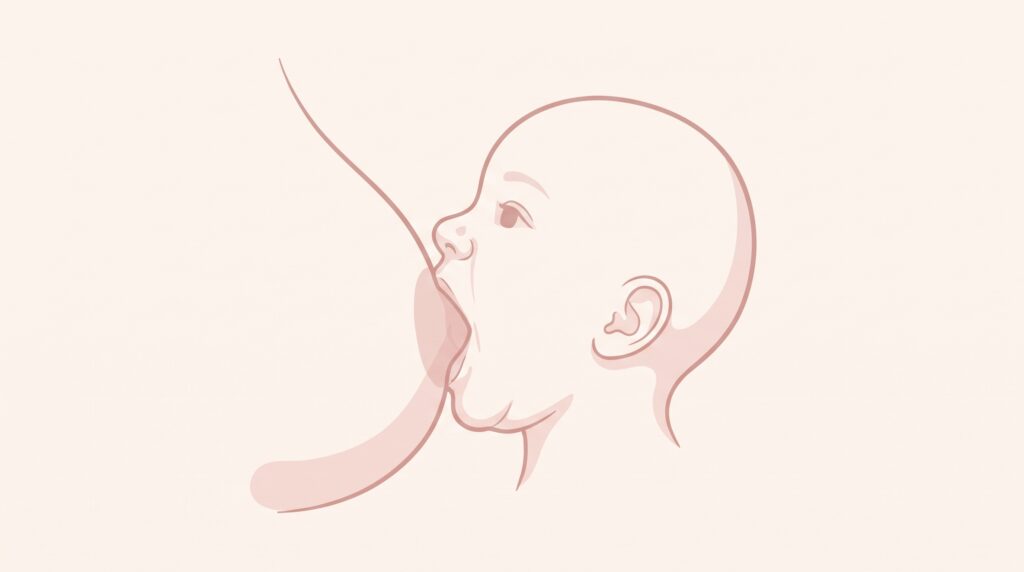
What is a latch: A latch is a baby’s ability to latch on to the breast, even if it’s dark — not just the nipple, but the entire areola (the dark ring around the nipple).
A good latch looks like this: ✅ Baby’s mouth is open ✅ Baby’s chin touches the breast ✅ Baby’s nose is clean ✅ Lips are puffy ✅ Mom feels a slight tug on the breast!
Signs of a bad latch: ❌ Sharp pain or a cutting sensation in the nipple ❌ Baby’s nipples are sticking out (sucking sound) ❌ Baby stops feeding too quickly
If the latch is bad: Break the seal by placing your little finger in the corner of your baby’s mouth – then try again. A bad latch can damage the nipple and your baby may not get enough milk.
Breastfeeding Positions

No one position works for everyone – try and see what’s comfortable:
Holding a hammock
Hold the baby in your arms, head in the crook of your elbow – the most traditional position.
Cross Cradle Hold
Baby’s head support cradle from opposite arm – gives new moms more control. Perfect for the first week!
Football Hold
Baby on the side, under the armpit, in the “football” position — good for C-section mothers because it doesn’t put pressure on the tummy.
Side lunge
Feed while lying on either side — perfect for nighttime feeds!
Leadback/Biological Nurturing
Mom reclines, baby on top of stomach – gravity helps with latching.
How often should you feed?
Newborn (first few weeks):
- 8-12 times per 24 hours – yes, that many times!
- About every 2-3 hours — both day and night
- Demand to feed – whenever the baby shows signs of hunger.
Signs of a baby’s hunger:
- To put one’s hand in the sand
- Roots (turning the face to one side)
- Sucking movements
- Tie hands
- Anxiety
Crying – a sign of late hunger! Don’t wait until crying – the sooner you notice the signs, the better the latch will be.
One side or both? First empty one side completely – then offer the other. Switch sides when the feed is gone.
Milk supply – who is responsible?

It is very important to understand:
Demand = Supply
The more you feed your baby — the more milk you will make. It’s a beautiful supply-demand system!
To increase your milk supply: ✅ Frequent feedings — most effective ✅ Complete drainage — empty the drain properly on all sides ✅ Skin-to-skin contact ✅ Proper hydration — 8-10 glasses of water a day ✅ Proper nutrition — especially oats, fenugreek affect the supply
Signs that your milk supply is working:
- The child is constantly hungry, never full.
- Wet diaper work (6 to work per day after the first week)
- Not gaining weight
If concerned – see a lactation consultant!
Common breastfeeding problems
Nipple pain
When: First week — especially days 3-5 Why: Nipples are adjusting, especially if the latch isn’t right
Relief:
- Latch check crane – this is the most important.
- After feeding, apply a little milk to the nipple and pat dry.
- Lanolin cream is safe.
- Helps with air drying.
- Nipple shields (check with the doctor first)
Severe pain even after week 2 – Mylen from a lactation consultant
Engagement
What is it: Breasts that are very full, hard, and painful during lactation
Relief:
- Frequent feeding – the best solution
- Apply warm compresses before feeding.
- Apply a cold compress after feeding.
- Light massage
- Ibuprofen (check with your doctor)
Blocked drain
What it is: A hard, painful lump in one spot
Relief:
- Frequent feeding — affected side
- Warm compress
- Massage the affected side during feeding
- Try different positions.
Important: A blocked duct can lead to mastitis if left untreated!
Mastitis
What is: Breast infection – with flu-like symptoms (fever, body aches, red swelling)
What to do: See a doctor – antibiotics may be needed. Continue breastfeeding – milk is safe for baby!
Thrush
What is: Yeast infection – burning sensation on nipples, shooting pain when feeding
Symptoms: white patches in baby’s mouth, unusually painful nipples
What to do: See a doctor – antifungal treatment may be needed – for both baby and mother
Pumping – when and to whom?

Kevin Pump Crane:
- Feeding a partner or family member
- After returning to work
- To increase milk supply
- Relief from engorgement.
When to start:
- If breastfeeding is well established — after week 3-4
- If there is a medical issue — quickly from day one
Pumping tips:
- The best time to pump is in the morning, after which milk is more abundant.
- It’s important to relax—stress reduces pumping.
- The image or scent of a baby improves milk flow (the oxytocin trick!)
- Hospital grade pump is more efficient
Guidelines for stored milk:
- Room temperature: 4 hours
- Refrigerate: 4 days
- Freezer: 6 months
Formula – When to consider a crane?
This is a sensitive topic – and I speak honestly:
When might a formula be necessary or appropriate:
- The baby is not gaining weight.
- Mother’s health problem
- Some of the mother’s medications
- Serious milk supply problems that will not be solved.
- Mother’s personal choice
Key message: Feed is great. If breastfeeding isn’t working — for whatever reason — a formula-fed baby is still a perfectly healthy baby. The mother’s mental health and the baby’s nutrition are important.
Feeling guilty, breastfeeding didn’t work — you tried, you’re a good mom.
Weaning – when and to whom?
WHO recommendation:
- Exclusive breastfeeding: up to 6 months
- Breastfeeding with solids: Up to 2 years or longer for us
But: Every family’s situation is different – this decision will be made by the mother and the doctor.
Gradual weaning:
- One by one, the finale of the crane – suddenly the bandmate crane (emotional and emotional impact)
- Introduce your baby to a cup or bottle gradually.
- Feeding slowly is usually the last resort.
Breastfeeding Support — Help Lena is Normal!
Breastfeeding comes naturally—but it also takes practice! Both are true.
Where to get help:
- Lactation Consultant (IBCLC): Certified Specialist – Best Resource
- La Leche League: International breastfeeding support organization
- Pediatrician: Child weight check and guidance
- Online Communities: Support from Real Moms
Quick Reference Table
| Issue | Solution |
|---|---|
| Sore nipples | Leach check, lanolin, air dry |
| Short supply | More frequent feeding, hydration |
| Engagement | Frequent feeding, hot/cold compresses |
| Blocked drain | More feeding, massage, warm compresses |
| Mastitis | Doctor – Antibiotics |
| The baby is not gaining weight. | Lactation consultant, pediatrician |
Frequently Asked Questions
Q: Is it normal to have pain while breastfeeding? A little discomfort for the first few days is normal — but sharp, ongoing pain is not normal. Check with a lactation consultant and see a lactation consultant.
Q: How do you know if your baby is getting enough milk? Wet diaper count — more than 6 per day after week 1, consistent weight gain, and feeding your baby.
Q: Does breastfeeding not cause a period? It usually delays the start of breastfeeding — but it is not 100% effective!
Q: Does breastfeeding not cause a period? Most everything — moderate caffeine is fine, alcohol occasionally, and wait 2-3 hours before feeding. Some babies react to certain foods — watch out for the doctor.
Q: Is pumped milk as good as direct breastfeeding? The nutrition is almost the same — but in direct breastfeeding, the composition of the milk is adjusted according to the baby’s needs, which is not the case with pumped milk.
The last thing
Breastfeeding is a journey and every journey is different. For some moms it’s a breeze, for others it’s challenging. Dono has the right experience.
If you’re struggling — ask for help. Talk to a lactation consultant. Share your feelings. And remember — every day of breastfeeding you’re able to give is a gift. Whether it’s a week or a year.
And if breastfeeding doesn’t work — you tried, you cared, you’re a good mom. A formula-fed baby will be just as healthy, sweet, and amazing.
At Little Heartbeat, we believe — every mom’s journey is unique, and every journey deserves support. 🌸
What’s the hardest part of breastfeeding for you? Share it in the comments — it’ll help other moms! And follow our TikTok!
This article is for educational purposes only. Please consult your lactation consultant or doctor for any concerns you may have regarding breastfeeding.